


Nigeria’s Security Crisis: A Foreign Strike Ignites Domestic Reckoning
As Nigeria ushers in 2026, the reverberations of a U.S. air strike on Christmas Day in Sokoto continue to echo, starkly illuminating the nation’s pervasive and debilitating insecurity. This rare instance of foreign military intervention has ignited a fervent national debate, probing the government’s capacity to safeguard its populace and the increasingly blurred boundaries between national sovereignty and international collaboration.
The operation, ostensibly targeting ISIS-linked terrorists in Sokoto, was characterized by U.S. President Donald Trump as a direct response to the “mass slaughter” of Christians. This narrative, however, has been contested by the Nigerian government, which emphasizes the multifaceted and complex nature of the security threats facing the country. While proponents view the strike as a crucial measure to combat terrorism, a significant segment of the population expresses grave concerns about its implications for national sovereignty and the potential for further escalation of violence.
Some observers, like social media user @Ishaq Samaila, have posited the strike as a precise intelligence-driven operation and a potent warning signal. They argue that the United States has stepped in where the Nigerian government has demonstrably struggled for years. This perspective prompts a critical question: is Nigeria truly lacking the capability to manage its security challenges, or is its approach to insecurity a product of intricate political calculations?
The genesis of this heightened tension can be traced back to late October, when U.S. President Donald Trump designated Nigeria a Country of Particular Concern (CPC) under the International Religious Freedom Act. This designation was predicated on alleged mass killings of Christians by extremist groups, with Mr. Trump issuing a stark warning that continued violence could jeopardize U.S. aid and even provoke military action. The CPC designation effectively placed Nigeria back on a list of nations that Washington perceives as tolerating or failing to adequately address severe violations of religious freedom.
In the initial days of November, President Trump amplified his concerns through pointed social media posts, instructing the U.S. defense establishment to prepare for potential intervention in Nigeria unless its government ceased what he described as the “mass slaughter” of Christians. Nigerian authorities vehemently rejected this religious framing of the crisis, asserting that the insecurity plaguing the nation is a complex issue impacting all communities, not solely Christians. Despite this initial pushback, Nigeria eventually agreed to collaborate with the U.S. on counterterrorism efforts.
In the lead-up to the December 25-26 air strike, increased U.S. military surveillance was observed over Nigerian airspace, widely interpreted as preparatory reconnaissance missions.
Following the strike, both Abuja and Washington officially confirmed it as a coordinated U.S.-Nigeria counterterrorism operation. Nigeria’s Minister of Foreign Affairs, Yusuf Tuggar, stated that President Bola Tinubu had approved the operation and provided crucial intelligence. Both nations underscored their shared threat assessments, strategic planning, and tactical cooperation aimed at degrading terrorist networks while unequivocally respecting Nigeria’s sovereignty.
Despite these official pronouncements, the U.S. air strike in Sokoto has generated a host of pressing questions that remain unanswered. Public verification of the operation’s specifics is notably limited. Reports from the strike vicinity indicate that debris from expended munitions landed near the Sokoto village of Jabo and in Offa, a neighboring town in Kwara State. Residents in both locations discovered fragments and wreckage following the explosions. A Pentagon video purportedly showing a missile launch from a U.S. naval platform in the Gulf of Guinea has been linked by U.S. officials to the operation in Nigeria.
Independent verification of the precise location and timing of the strike is scarce. While the Nigerian government maintains that no civilians were harmed, official security reports detailing the operation’s outcomes are still conspicuously absent. Crucially, the number of terrorists neutralized remains undisclosed. Consequently, both Nigerian and U.S. authorities have offered no clear updates, leaving the public in a state of anxious anticipation for answers.
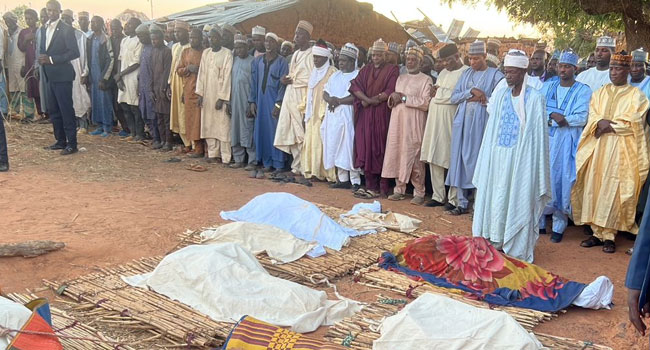
The air strike occurs against a backdrop of persistently worsening insecurity across Nigeria. Shortly before the U.S. operation, a mosque bombing at the Al-Adum mosque in Maiduguri, Borno State, claimed the lives of at least five worshippers and injured approximately 35 others during evening prayers. Furthermore, a bombing incident in Zamfara State took place shortly after the U.S. strike.
In a separate incident, at least seven people were killed when an improvised explosive device detonated along the Magami–Dansadau Highway in the Maru Local Government Area of Zamfara State.
These recent attacks, alongside a litany of other violent incidents, underscore the escalating nature of insecurity in Nigeria. This grim reality fuels the argument among many Nigerians that the U.S. air strike should be extended to other affected regions in the North without delay. However, the absence of clear communication from the government regarding the operation’s success leaves citizens without reassurance and without hope that coordinated actions, potentially including continued U.S. support, can effectively counter the insurgency.
A Troubling Legacy of Insecurity
The statistics paint a grim picture: between 2009 and 2025, over 40,000 Nigerians are estimated to have been killed and more than 100,000 abducted in incidents involving banditry, insurgency, and kidnapping. Tens of thousands more have been displaced. Despite this devastating toll, the Nigerian government’s response to terrorism has frequently appeared hesitant rather than decisive. The escalating insecurity has often been met with slow, piecemeal measures, leaving countless communities vulnerable as criminal networks have expanded their reach and influence.
This perceived inadequacy has led many Nigerians to question whether the government’s approach stems from incapacity, negligence, or a deliberate political calculation. Specifically, some analysts suggest that political considerations related to the upcoming 2027 elections, coupled with fears of alienating the Northern region, may have constrained federal action against insecurity.
Persistent allegations that terrorists enjoy protection from local collaborators and political elites are further amplified by government reluctance and certain public statements, which only serve to reinforce these perceptions. Investigative reports frequently highlight instances of kidnappings concluding without any transparent explanation of the resolution process.
President Bola Tinubu recently ignited renewed debate with his comments on the release of schoolchildren abducted from Kebbi and Niger states. He stated, “The rhetoric on how the children were released or what happened to the kidnappers is secondary; the end justifies the means.” This statement was interpreted by many Nigerians as a troubling indication that transparency is being sacrificed for political optics, thereby lending credence to allegations that the government may have facilitated or negotiated with bandits to achieve desired outcomes.
Further fueling these suspicions is a viral video circulating in mid-December, in which a former aide to ex-Zamfara Governor Bello Matawalle claimed that the governor’s office provided vehicles and other support to notorious bandit leaders, including Bello Turji. Turji himself, in a subsequent video, acknowledged meeting with Matawalle during televised peace talks but vehemently denied receiving any cash payments. He recounted that operations under Matawalle’s tenure included airstrikes that resulted in the deaths of family members.
Religious Leaders and Political Influence
Religiously influential figures have also become focal points in the ongoing debate. Sheikh Ahmad Gumi, a prominent Islamic cleric known for his role as an intermediary between bandits and authorities, has sharply criticized the U.S. air strike and Nigeria’s security cooperation with the United States. Beyond his long-standing opposition to U.S. intervention, Gumi recently urged the Nigerian government to cease military collaboration with the U.S., warning that foreign airstrikes could transform Nigeria into “a theatre of war.”
Despite widespread calls from Nigerians and various civil society groups for Sheikh Gumi’s arrest, stemming from his repeated characterization of terrorists as “the Nigerian” children, segments of the media have played a role in amplifying his views by granting him numerous interviews. This suggests that, by extension, parts of the media and the political class may be prioritizing ideological positioning over the lived realities of Nigerians besieged by pervasive violence.
Significantly, none of the individuals implicated in these controversies, including former Governor Matawalle, have been arrested or investigated by the Department of State Security. The government’s apparent tolerance of Sheikh Gumi’s continued media engagements raises a pertinent question: will his advice regarding the U.S. strike now be heeded?
These controversies collectively highlight how insecurity in Nigeria has transcended mere acts of violence. It has become deeply enmeshed with the country’s political landscape, public trust, and national identity. Internationally, Nigeria’s image has suffered. Even if the government appears undeterred by the loss of life within its borders, it must acknowledge the clear diplomatic and economic repercussions of its inability to curb insecurity, which can range from investor caution to the erosion of international partnerships.
The question remains: Is the U.S. strike a necessary tactic to force action, or does it represent an unwelcome intrusion? While some may view the strike as a form of “shame tactic” designed to spur the Nigerian government into more decisive action, others express profound concerns over national sovereignty, particularly when foreign forces operate unilaterally within a domestic crisis. Ultimately, the critical takeaway is that Nigeria must reclaim control of its security narrative, ensuring that its citizens, rather than external powers, dictate how the nation confronts its vulnerabilities.
Transparency is no longer an option; it is an urgent imperative. Nigerians are owed clear and public reports detailing the outcomes of the Sokoto strike: the number of terrorists neutralized, verified accounts of civilian safety, and concrete evidence of operational success. The Federal Government bears a profound responsibility to act decisively, both militarily and diplomatically, to prevent the recurrence of such crises. Policy must be crafted to break the cycles where political ambition intersects with insecurity, rather than exploiting it. Citizen scrutiny is paramount; Nigerians must hold their government accountable, demand clarity, and insist that security is prioritized above all political considerations.











Discussion about this post