

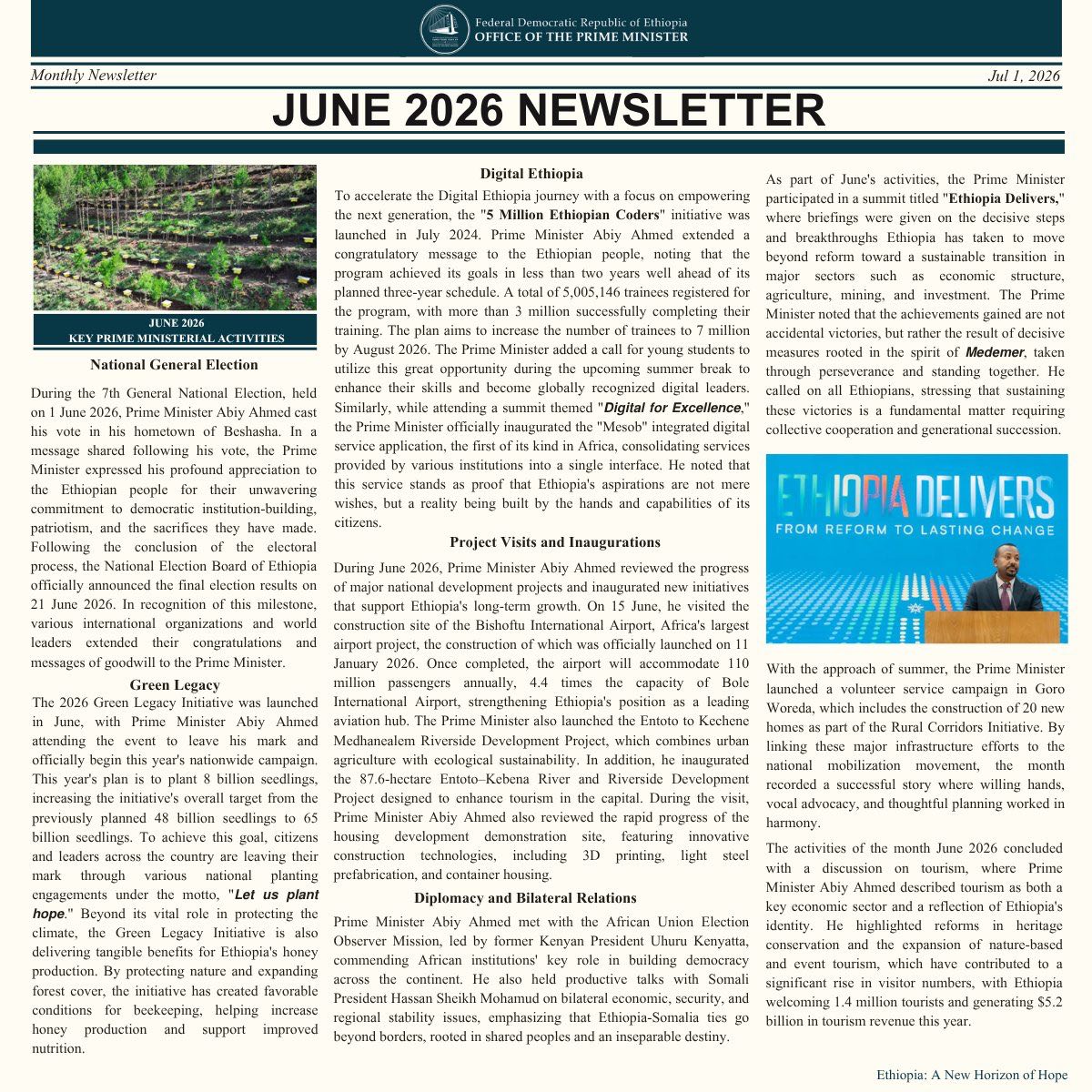
Ethiopia’s Recent Achievements in Governance and Development
Ethiopia has made significant progress in various areas, including democratic governance, digital innovation, and infrastructure development. These achievements highlight the country’s commitment to national productivity and long-term economic growth.
Democratic Governance and Electoral Success
One of the most notable achievements was the successful conclusion of Ethiopia’s 7th General National Election. The National Election Board of Ethiopia officially announced the final results on 21 June 2026. Prime Minister Abiy Ahmed cast his ballot in Beshasha and praised citizens for their peaceful participation, patriotism, and dedication to strengthening democratic institutions. International organizations and global leaders also recognized Ethiopia’s progress in democracy.
Digital Innovation and Transformation
Ethiopia has reached a major milestone in its digital transformation journey. The government’s “5 Million Ethiopian Coders” initiative exceeded its initial target, registering over five million participants and graduating more than three million digitally skilled professionals in less than two years. The government has now set a new goal to enroll seven million Ethiopians by August 2026, positioning the country as an emerging digital innovation hub in Africa.
Additionally, the launch of MESOB, Africa’s first integrated digital public service platform, marked another important step toward modernizing public administration. This platform brings together services from multiple government institutions into a single, user-friendly application.
Infrastructure Development
Major infrastructure projects have continued to gain momentum. The construction of the Bishoftu International Airport is progressing rapidly, with the future aviation hub designed to accommodate 110 million passengers annually. This will expand Ethiopia’s airport capacity to approximately 4.4 times that of Bole International Airport, reinforcing the country’s position as one of Africa’s leading aviation gateways.
In Addis Ababa, the urban transformation agenda reached another milestone with the inauguration of the 87.6-hectare Entoto–Kebena River and Riverside Development Project, alongside the launch of the Entoto–Kechene Medhanealem Riverside Development Project. Innovative housing developments using 3D printing technology and light-steel prefabrication reflect Ethiopia’s growing emphasis on sustainable, technology-driven urban development.
Environmental Conservation and Rural Development
Environmental conservation remains a national priority. The government launched the 2026 Green Legacy Initiative, increasing its cumulative national target to 65 billion tree seedlings. Under the theme “Let Us Plant Hope,” Ethiopia plans to plant eight billion seedlings during the current rainy season, aiming to expand forest cover, restore degraded landscapes, strengthen climate resilience, and support rural livelihoods, including increased honey production.
A nationwide summer volunteer campaign was launched in Goro Woreda, mobilizing communities to construct 20 new homes under the Rural Corridors Initiative. This highlights the government’s continued focus on inclusive rural development and community participation.
Regional Cooperation and Diplomacy
Ethiopia reinforced regional cooperation through high-level engagements. Prime Minister Abiy held productive consultations with the African Union Election Observer Mission, led by former Kenyan President Uhuru Kenyatta, and conducted bilateral discussions with Somali President Hassan Sheikh Mohamud on strengthening regional peace, security, economic cooperation, and shared prosperity.
Economic Growth and Tourism
The government’s broad development achievements were reviewed during the “Ethiopia Delivers” summit, where officials highlighted ongoing structural transformations in agriculture, mining, investment, industrialization, and public sector reform under the Medemer development philosophy.
These reforms are translating into measurable economic gains. Ethiopia’s tourism sector welcomed 1.4 million international visitors over the past year and generated a record USD 5.2 billion in revenue, underscoring the growing global appeal of the country’s expanding tourism destinations, rich cultural heritage, and sustained investment in world-class infrastructure.
Conclusion
The Office of the Prime Minister stated that the achievements recorded over the past month reflect Ethiopia’s continued commitment to democratic consolidation, technological advancement, sustainable development, and regional cooperation as the country pursues its long-term vision of inclusive prosperity and economic transformation.


Tinggalkan Balasan